

Robotic palletizing systems automate the process of stacking bags, cartons, cases, and other packaged products onto pallets for storage, handling, and shipment. These systems are widely used in manufacturing, packaging, warehousing, and bulk material handling operations where consistent pallet loads and efficient production are essential.
As manufacturers face increasing pressure to improve productivity, reduce repetitive manual handling, and maintain consistent packaging operations, robotic palletizing has become an important automation solution.
Modern robotic palletizers can be configured for different product sizes, weights, pallet patterns, and production requirements. Depending on the application, manufacturers may choose a compact collaborative robotic palletizer, a conventional industrial robotic system, or a fully integrated turnkey palletizing line.
Table of Contents
What Is a Robotic Palletizing System?
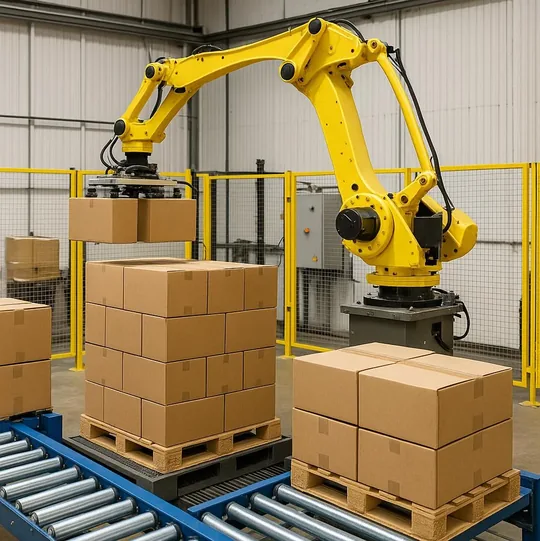
A robotic palletizing system uses a programmable robotic arm equipped with specialized end-of-arm tooling to pick products from a conveyor or designated pickup location and arrange them onto a pallet according to a predetermined stacking pattern.
A typical system may include:
- Industrial or collaborative robotic arm: Performs the programmed product-handling movements.
- End-of-arm tooling: Grippers, vacuum systems, or other tooling designed for the products being handled.
- Product infeed conveyor: Delivers bags, cartons, or cases to the robot’s pickup position.
- Pallet positioning equipment: Holds empty pallets in the correct loading location.
- Controls and safety systems: Coordinate operation and provide appropriate safeguards.
- Optional automation equipment: Pallet dispensers, slip-sheet dispensers, pallet conveyors, and stretch-wrapping equipment.
The system repeatedly picks and places products according to the programmed pallet pattern until the load is complete.
Robotic palletizing systems can operate as standalone workstations or as part of a larger, fully integrated packaging and material handling line.
Types of Robotic Palletizing Systems
Robotic bag palletizing systems automate the stacking of filled bags containing powders, granules, pellets, grains, chemicals, and other bulk materials. These systems are commonly used in food processing, agriculture, chemical manufacturing, and industrial packaging operations.
Bag palletizing requires careful consideration of bag dimensions, weight, material characteristics, and stacking patterns. Depending on the application, robotic systems may use specialized mechanical grippers, fork-style tooling, or other end-of-arm handling equipment.
Properly designed robotic bag palletizers can provide consistent pallet patterns, reduce repetitive manual lifting, and integrate with existing bagging and conveying equipment.
Robotic Bag Palletizing
Robotic bag palletizing systems automate the stacking of filled bags containing powders, granules, pellets, grains, chemicals, and other bulk materials. These systems are commonly used in food processing, agriculture, chemical manufacturing, and industrial packaging operations.
Bag palletizing requires careful consideration of bag dimensions, weight, material characteristics, and stacking patterns. Depending on the application, robotic systems may use specialized mechanical grippers, fork-style tooling, or other end-of-arm handling equipment.
Properly designed robotic bag palletizers can provide consistent pallet patterns, reduce repetitive manual lifting, and integrate with existing bagging and conveying equipment.
Robotic Case Palletizing
Robotic case palletizing systems automatically arrange cartons, boxes, and packaged products onto pallets according to programmed stacking patterns.
These systems are widely used in manufacturing, food and beverage packaging, consumer goods production, and distribution operations. Depending on carton construction, weight, and handling requirements, robotic case palletizers may use vacuum grippers, mechanical gripping systems, or other specialized end-of-arm tooling.
Robotic case palletizers can be configured for different case sizes, production rates, pallet dimensions, and stacking arrangements. They can operate as standalone workstations or integrate with existing packaging conveyors and downstream pallet handling equipment.
Key Benefits of Robotic Palletizing Systems
Robotic palletizing offers manufacturers several operational advantages, particularly in facilities with repetitive end-of-line packaging and material handling requirements. The benefits depend on production volumes, product characteristics, equipment selection, and system integration.
- Improved Productivity: Robotic palletizers can provide consistent handling cycles and support continuous production when properly matched to line requirements.
- Reduced Manual Handling: Automating repetitive lifting and stacking tasks can reduce physical demands on employees and improve workplace ergonomics.
- Consistent Pallet Patterns: Programmable stacking arrangements help produce uniform pallet loads, improving handling consistency and supporting load stability.
- Operational Flexibility: Many robotic palletizing systems can accommodate multiple product sizes, pallet configurations, and stacking patterns through appropriate programming and tooling.
- Efficient Use of Floor Space: Compact palletizing workstations can provide automation options for facilities where available production space is limited.
- Long-Term Cost Efficiency: By reducing repetitive manual tasks and improving handling consistency, robotic palletizing may lower operating costs over time. Actual savings depend on production requirements, equipment costs, and utilization.
How to Choose the Right Robotic Palletizing System
Selecting the right robotic palletizing system requires evaluating your production requirements, product characteristics, available floor space, and long-term automation objectives. A properly selected system should provide the necessary handling capacity while integrating efficiently with your existing packaging operations.
Important factors to consider include:
- Product Type and Weight: Determine whether the system will handle bags, cartons, cases, or other products. Product dimensions, weight, and handling characteristics influence robot selection and end-of-arm tooling.
- Production Throughput: Establish the required number of bags or cases per minute. The robotic system must be capable of maintaining the required production rate under actual operating conditions.
- Robot Payload and Reach: Evaluate the combined weight of the product and gripper, along with the reach required for the intended pallet positions and stacking height.
- Pallet Patterns and Dimensions: Consider pallet sizes, stacking arrangements, maximum load heights, and whether multiple pallet patterns will be required.
- Available Floor Space: Assess the space available for the robot, product conveyors, pallet positions, operator access, and required safety equipment.
- System Integration: Determine how the palletizer will interface with existing conveyors, packaging equipment, controls, and downstream material handling systems.
Auctech AWP Series Collaborative Robotic Palletizers
The Auctech AWP Series offers compact, integrated collaborative robotic palletizing workstations designed for end-of-line packaging applications. These systems combine a robotic arm with palletizing equipment in a workstation configuration that can be evaluated for integration into existing production environments.
The AWP Series includes six models: AWP-20S, AWP-20, AWP-20L, AWP-40S, AWP-40, and AWP-40L. Across the series, robot payload capacities range from 20 kg to 50 kg, with maximum reaches ranging from 1,480 mm to 1,980 mm, depending on the model.
Robot payload capacity includes the weight of the end-of-arm tooling. Consequently, the allowable product weight is lower than the robot’s rated payload and must be confirmed for each application.
The manufacturer’s standard configurations are intended for carton palletizing. Bag palletizing applications may also be considered, but require appropriate gripper design, product evaluation, and engineering confirmation.
Saturn Robotics can assist manufacturers with evaluating Auctech AWP workstation configurations, selecting suitable equipment, and determining integration requirements for their packaging operations.
Conclusion: Finding the Right Robotic Palletizing Solution
Robotic palletizing systems offer manufacturers a practical way to automate repetitive end-of-line packaging operations, improve palletizing consistency, and reduce manual material handling requirements.
Whether your application involves industrial bags, cardboard cases, or other packaged products, selecting the right robotic palletizer requires careful consideration of product characteristics, production throughput, robot payload, available floor space, and integration requirements.
Saturn Robotics provides robotic palletizing equipment and complete turnkey integration solutions tailored to industrial packaging applications. From compact Auctech AWP collaborative palletizing workstations to customized robotic bag and case palletizing systems, our team can help evaluate your requirements and recommend a suitable automation solution.
Planning a robotic palletizing project? Contact Saturn Robotics to discuss your application and request a quotation.