
Choosing a robotic palletizing system is an important decision for manufacturers looking to improve productivity, reduce repetitive manual handling, and maintain consistent pallet loads. The right system must do more than move bags or boxes from a conveyor onto a pallet. It must accommodate your products, production rates, available floor space, and future operating requirements.
Whether you are considering robotic bag palletizing, case palletizing, or an integrated end-of-line solution, understanding the following factors will help you make an informed equipment selection.
Understanding Robotic Palletizing Applications
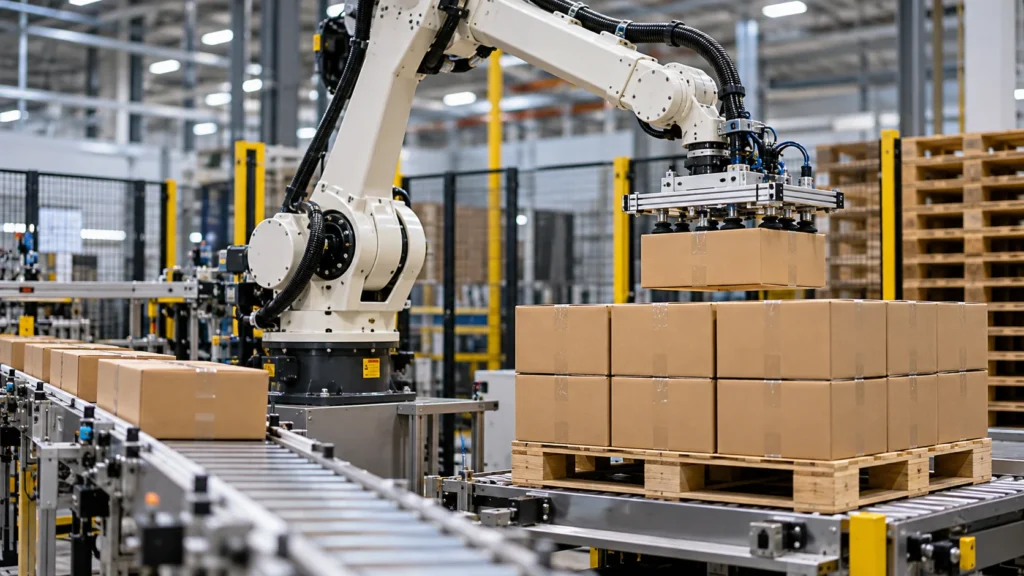
A robotic palletizer uses a programmed robot and suitable end-of-arm tooling to pick up packaged products and place them in a defined pallet pattern. Depending on the installation, it can be integrated with conveyors, pallet handling equipment, and downstream stretch wrapping.
Bag Palletizing Versus Case Palletizing
Bag palletizing may involve paper, plastic, or woven bags containing powders, granules, animal feed, or food ingredients. Bag weight, flexibility, dimensions, and product settling affect handling.
Case palletizing typically involves corrugated cartons or boxes. Carton dimensions, structural strength, weight, and pallet patterns influence the system design. Facilities handling multiple package formats should also consider changeover requirements.
How a Robotic Palletizing System Works
Products arrive at a pickup location, usually from an upstream conveyor. The robot picks each product using application-specific tooling and places it at a programmed location on the pallet. The sequence repeats until the pallet pattern is complete, after which a finished pallet can be removed and replaced.
Key Components and Operating Features
- Industrial robot: Must provide suitable payload, reach, motion, and duty-cycle performance.
- End-of-arm tooling: Must grip or support the product reliably without damaging its packaging.
- Conveyors and pallet handling: Must deliver products consistently and allow completed pallets to exit the cell.
- Controls and safety systems: Coordinate the robot with upstream equipment and manage safe access and fault recovery.
Determine Your Required Production Rate
Establish the required bags or cases per minute, operating shifts, pallet patterns, and expected future throughput. A realistic performance assessment must consider the complete pickup-and-placement cycle, not simply the robot’s published maximum speed.
Cycle time is affected by product weight and dimensions, robot travel distance, pallet height, gripper operation, conveyor presentation, and pallet exchange time.
Choosing a Robotic Palletizing System: Robot Payload and Reach
Payload must include the product and the weight of the end-of-arm tooling, subject to the robot manufacturer’s specifications. Reach must cover the pickup location and every placement position on the pallet, including the highest and farthest points.
Review pallet footprint, maximum stack height, product orientation, and the surrounding equipment layout before selecting a robot model.
Select the Right End-of-Arm Tooling
Vacuum gripping may suit certain cartons, while mechanical or supporting grippers may be more appropriate for bags or packaging with irregular surfaces. Tooling selection should account for product stability, package strength, speed, and the risk of damage.
For multiple package sizes, adjustable or interchangeable tooling may offer useful flexibility.
Compare Common Application Requirements
| Selection factor | Bag palletizing | Case palletizing |
|---|---|---|
| Product characteristics | Flexible packaging; possible product settling | Rigid or semi-rigid cartons; variable carton strength |
| Tooling considerations | Supporting or mechanical handling may be needed | Vacuum or mechanical gripping, depending on carton |
| Pattern considerations | Bag orientation and stack stability | Carton orientation, layer patterns, and crush resistance |
| Changeovers | Bag size and weight variation | Carton dimensions and multiple SKUs |
Plan Floor Space, Safety, and Integration
Evaluate the full installation footprint, including conveyors, pallet infeed and outfeed, guarding, maintenance access, and operator movement. Compact all-in-one systems may reduce layout complexity, but the complete operating area still requires careful planning.
Safety measures must be based on an application-specific risk assessment and applicable standards. These may include guarding, interlocked access doors, emergency stops, and safety-rated sensing devices.
Confirm how the palletizer will interface with packaging machines, weighing systems, conveyors, pallet dispensers, stretch wrappers, and existing plant controls. For larger projects, complete turnkey palletizing systems can provide a coordinated approach to equipment and integration.
Consider Future Production Needs and Total System Value
Future product sizes, pallet patterns, production rates, and operating schedules may change. Evaluate whether the system can adapt without extensive modifications.
Compare not only purchase price but also installation, commissioning, training, maintenance, spare parts, integration responsibilities, and supplier support. The lowest initial price does not necessarily represent the best long-term value.
Questions to Ask Before Selecting a System
- What are the minimum and maximum product weights and dimensions?
- How many bags or cases per minute must the system handle?
- What pallet sizes, patterns, and finished load heights are required?
- How much floor space is available, including safe access?
- What upstream and downstream equipment must be integrated?
- Are additional products or higher production rates expected?
Frequently Asked Questions
Can one robotic palletizer handle different products?
Often, yes, provided the robot, tooling, controls, and pallet patterns are designed for the required range of products. The feasibility and changeover process must be evaluated for the specific application.
Is an all-in-one palletizer suitable for every facility?
No. Integrated systems can be attractive for compact layouts and straightforward installation, but higher-throughput or complex multi-line applications may require a more customized cell.
Conclusion
Choosing a robotic palletizing system requires a complete review of product characteristics, throughput, payload, reach, tooling, safety, layout, and integration. Evaluating the full production process helps manufacturers select equipment suited to current requirements and future changes.
Saturn Robotics supplies bag and case palletizing solutions, including the Auctech AWP all-in-one series and integrated turnkey systems. Explore our robotic palletizing systems or request a quote to discuss your products, production rate, and plant layout.
Technical reference: FANUC — Palletizing Applications.