

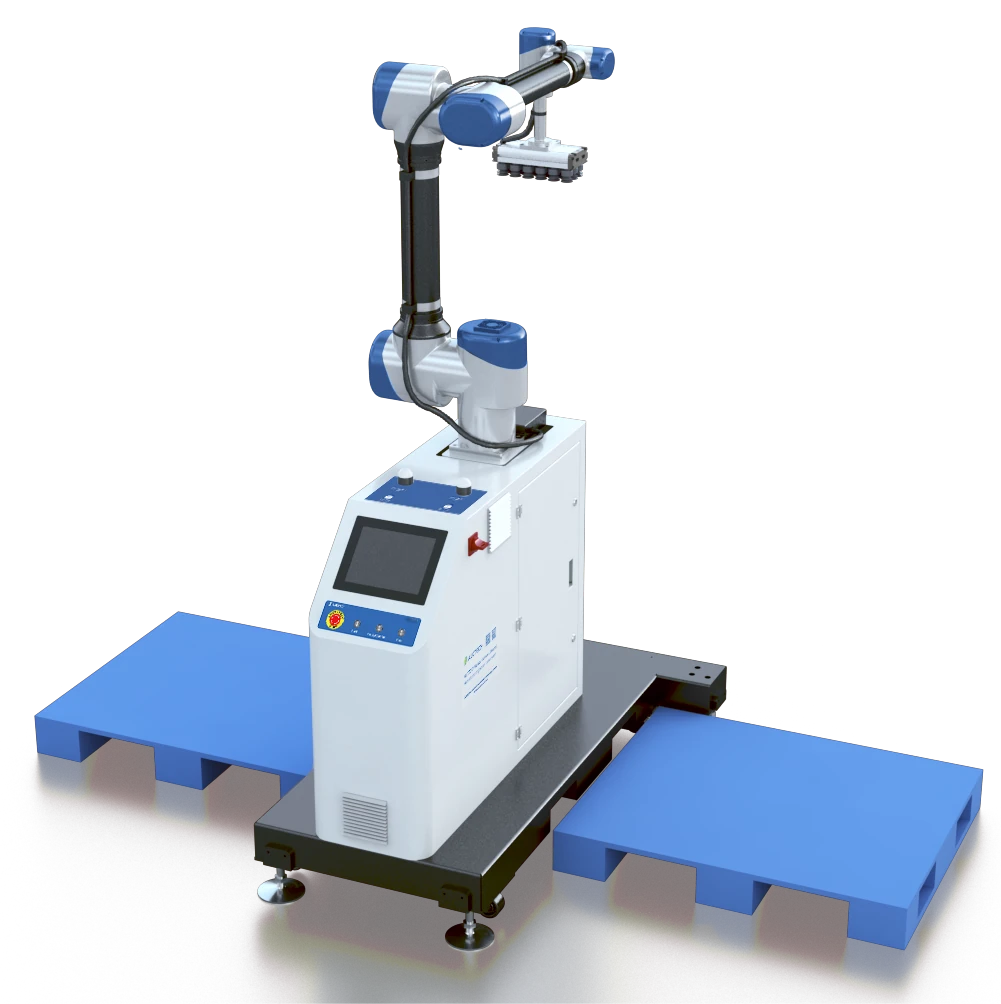
Manufacturers handling cartons, boxes, and other packaged products often face challenges associated with repetitive manual palletizing, changing production requirements, and limited floor space. All-in-one robotic palletizing systems offer an integrated approach to automating the final stages of a packaging line.
Rather than selecting and integrating every component independently, manufacturers can evaluate palletizing workstations that combine a robot, controller, end-of-arm tooling, pallet positioning, and associated equipment into a coordinated system.
The AUCTECH AWP Series is one example of this approach. Understanding its capabilities and limitations can help manufacturers determine whether an integrated palletizing workstation is appropriate for their operation.
Understanding All-in-One Robotic Palletizing Systems
An all-in-one robotic palletizing workstation is designed to automate the transfer of packaged products from an incoming conveyor or pickup position onto a pallet.
A typical workstation includes a robotic arm, control system, product gripper, pallet positioning arrangement, and the necessary interfaces for coordinating equipment operation.
The objective is to simplify system integration while providing repeatable product placement according to programmed pallet patterns.
However, an integrated workstation is not necessarily a complete turnkey robotic palletizing solution. Additional conveyors, safety equipment, pallet handling, and facility modifications may still be required.
How an Integrated Robotic Palletizer Works
During operation, packaged products arrive at a designated pickup location. The robot uses its end-of-arm tooling to grip the product, transfer it to the pallet, and position it according to a programmed stacking pattern.
The process repeats as additional products arrive. Depending on the equipment configuration, the system may support different pallet patterns and product arrangements.
Key Components and Operating Features
- Robotic arm: Moves products between the pickup position and pallet.
- End-of-arm tooling: Uses a suitable gripping method, such as vacuum or mechanical gripping, according to product characteristics.
- Robot controller: Coordinates robot movements, operating sequences, and communication with connected equipment.
- Pallet positioning system: Establishes the pallet location required for accurate product placement.
- Conveyor interface: Coordinates incoming product availability with the robot’s operating cycle.
- Safety equipment: Provides application-specific safeguards determined through a risk assessment.
The AUCTECH AWP Series
AUCTECH manufactures the AWP Series of collaborative robotic palletizing workstations.
According to the manufacturer’s published specifications, the series includes six models with different payload and reach combinations.
| Model | Rated Payload | Robot Reach |
|---|---|---|
| AWP-20S | 30 kg | 1,480 mm |
| AWP-20 | 25 kg | 1,680 mm |
| AWP-20L | 20 kg | 1,880 mm |
| AWP-40S | 50 kg | 1,580 mm |
| AWP-40 | 45 kg | 1,780 mm |
| AWP-40L | 40 kg | 1,980 mm |
Important: Rated payload is not the same as maximum product weight. The payload must accommodate the end-of-arm tooling and the handled product. AUCTECH’s published AWP-20 specifications, for example, identify a 25 kg rated payload, a 7 kg suction assembly, and an 18 kg maximum carton weight for the specified configuration.
The manufacturer’s documentation also describes programmable palletizing patterns, pallet positioning, lifting arrangements, and options for different workstation configurations.
Manufacturer reference: AUCTECH AWP Series — Official Product Information
Benefits of Integrated Robotic Palletizing
1. Simplified Equipment Integration
An integrated workstation can reduce the number of individual equipment interfaces that must be engineered separately.
However, overall installation complexity depends on the existing production line, product flow, safety requirements, and any additional material handling equipment.
2. More Consistent Pallet Formation
Programmed robot movements allow products to be placed according to defined stacking patterns.
Consistent pallet formation depends on product dimensions, gripping reliability, incoming product presentation, and the suitability of the selected pallet pattern.
3. Reduced Repetitive Manual Handling
Robotic palletizing can automate repetitive lifting and stacking activities.
This may allow personnel to concentrate on other production responsibilities while reducing direct involvement in repetitive palletizing tasks.
4. Flexible Product and Pallet Configurations
Some integrated palletizing systems support multiple stored pallet patterns and operating recipes.
This can be useful where manufacturers handle different carton dimensions or production batches, provided each product configuration falls within the system’s operating limits.
5. Space-Efficient Equipment Arrangements
Compact workstation designs may offer advantages where production floor space is limited.
Actual space requirements must include robot movement, pallet access, conveyors, safety clearances, and maintenance access—not simply the equipment’s nominal footprint.
Common Industrial Applications
Robotic Case Palletizing
Case palletizing is a common application for integrated robotic workstations.
Products packaged in cartons or boxes can be transferred from a conveyor and arranged on pallets according to programmed stacking patterns.
Equipment selection depends on carton weight, dimensions, surface condition, required throughput, and pallet configuration.
Robotic Bag Palletizing
Robotic bag palletizing can also be applied to bagged products, including certain packaged powders, granules, and other industrial materials.
However, flexible bags introduce additional handling considerations. Product distribution, bag deformation, surface characteristics, and gripping requirements may necessitate specialized tooling.
A workstation designed primarily for cartons should not be assumed suitable for bags without a specific application review.
Engineering Considerations Before Selecting a System
Product Weight and Dimensions
Confirm the actual product weight and the total weight of the selected gripping assembly. The combined load must remain within the robot’s permitted payload and operating limits.
Production Throughput
Evaluate the required products per minute, incoming conveyor arrangement, pallet pattern, and total robot cycle time.
Published maximum cycle rates should not be treated as guaranteed production throughput.
Pallet Dimensions and Stacking Height
The robot must reach the required pickup and placement positions throughout the stacking cycle.
Pallet dimensions, finished stack height, and available overhead clearance must be evaluated together.
End-of-Arm Tooling
End-of-arm tooling, including vacuum grippers, mechanical grippers, and specialized gripping systems, must be selected according to the requirements of each application.
The correct tooling depends on product weight, packaging integrity, surface properties, and handling orientation.
Safety and Operator Access
Collaborative robot technology does not eliminate the need for a complete application-specific safety assessment.
The Canadian Centre for Occupational Health and Safety recommends assessing hazards associated with integration, operation, programming, and maintenance.
Depending on the application, additional guarding, presence-sensing devices, or other protective measures may be required.
However, an integrated workstation is not necessarily a complete turnkey robotic palletizing solution. Additional conveyors, safety equipment, pallet handling, and facility modifications may still be required.
How to Select the Right Robotic Palletizing System
Before choosing a palletizing workstation, manufacturers should establish the following operating requirements:
- Product type, weight, dimensions, and packaging characteristics.
- Required production rate and anticipated future capacity.
- Pallet dimensions, stacking patterns, and maximum load height.
- Available floor space and facility clearances.
- Incoming and outgoing conveyor arrangements.
- Required end-of-arm tooling.
- Safety, maintenance, and operator-access requirements.
- Integration with existing controls and production equipment.
These factors help determine whether a standard integrated workstation is appropriate or whether additional engineering and customization are necessary.
Frequently Asked Questions
What is an all-in-one robotic palletizing system?
It is an integrated workstation combining a robot with selected controls, tooling, pallet positioning, and related equipment to automate pallet stacking. The exact scope of the supplied system varies by manufacturer and configuration.
Can the same robot palletize bags and boxes?
Potentially, but the suitability depends on the product characteristics, robot capacity, and end-of-arm tooling. Different products may require different gripping systems and operating arrangements.
Does a collaborative robot eliminate the need for safety guarding?
No. Safeguarding requirements depend on the complete application and its documented risk assessment, including the robot, tooling, products, conveyors, and operator interaction.
How quickly can an integrated palletizer be installed?
Installation time depends on site readiness, utilities, conveyor integration, safety requirements, commissioning, and operator training. A manufacturer’s description of easy deployment should not be interpreted as a guaranteed installation schedule.
Conclusion
All-in-one robotic palletizing systems provide manufacturers with an integrated approach to automating repetitive product handling and pallet stacking.
The AUCTECH AWP Series offers several published payload and reach configurations, allowing manufacturers to evaluate different workstation sizes against their production requirements.
Successful implementation depends on selecting the correct robot, tooling, pallet configuration, safety measures, and production-line interfaces.
Discuss Your Robotic Palletizing Application
Saturn Robotics can help you evaluate robotic palletizing equipment and integration requirements for your operation.
Technical Disclaimer: Product specifications and capabilities referenced in this article are based on published manufacturer information. Actual system performance, payload capacity, throughput, and suitability depend on equipment configuration, end-of-arm tooling, product characteristics, and operating conditions. Specifications are subject to change without notice. Contact Saturn Robotics to confirm current specifications and application requirements.